Project Information
- Category: Talk
- Conference: 24th Annual Auditory Perception, Cognition and Action Meeting
- Authors: Lauren Petley
Challenging Listening Conditions Increase the Persistence of Cognitive Control in an Auditory Flanker Task
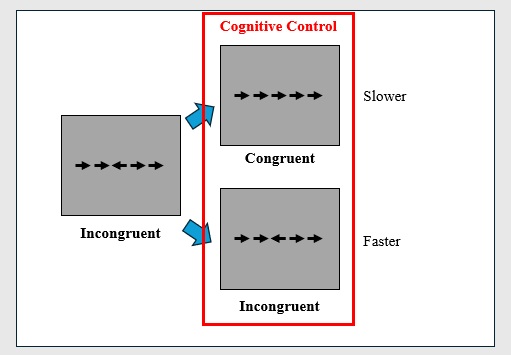
Flanker tasks are popular tools for studying executive function, notably conflict resolution – suppressing an incorrect response in order to produce the correct one. Applying sequence analyses to these tasks additionally reveals the time course of cognitive control, typically revealing two effects. If the next trial also involves conflict, it is resolved more readily due to preparation, producing faster response times. If it doesn’t, responses are slowed versus scenarios where no conflict was encountered. In a series of three experiments, we previously validated an auditory flanker task that uses spoken directional commands as stimuli. To explore the potential influence of masking, trials were also included that imposed masking effects. Using three different vocal configurations, 1) a woman versus a boy (F0 difference = 32.1 Hz), 2) a woman versus a man (F0 difference = 93.1 Hz), and 3) a man versus a girl (F0 difference = 122.8 Hz), we demonstrated that conflict was greatest when the spectral separation between voices was small. The present analysis applied a sequence analysis to these data to explore differences in the persistence of cognitive control. With the smallest amount of spectral separation, conflict significantly slowed the response on the next trial, compared to trials that only contained masking. This conflict effect was observed regardless of the category of the next trial. Increasing the spectral separation between the talkers reduced this conflict effect. Specifically, with moderate separation, the effect of conflict was modified by the category of the next trial, making it inconsistent, while only a near-significant conflict effect was observed with the greatest amount of spectral separation. Combined with our previous findings, this analysis reveals that challenging listening conditions not only increase the conflict that is evoked by simultaneous talkers, they lead to more persistent exertion of cognitive control in anticipation of future conflict.