
at Clarkson University on Saturday April 11th, 2026.
This conference is a student-driven research oral and poster presentations and panel discussions. The purpose of the conference is to foster collaborations within the Associated Colleges of the St. Lawrence Valley, provide career, REU and graduate school information, and to celebrate the success of mathematics students. Please encourage your faculty and students to participate in MCCNNY 2026.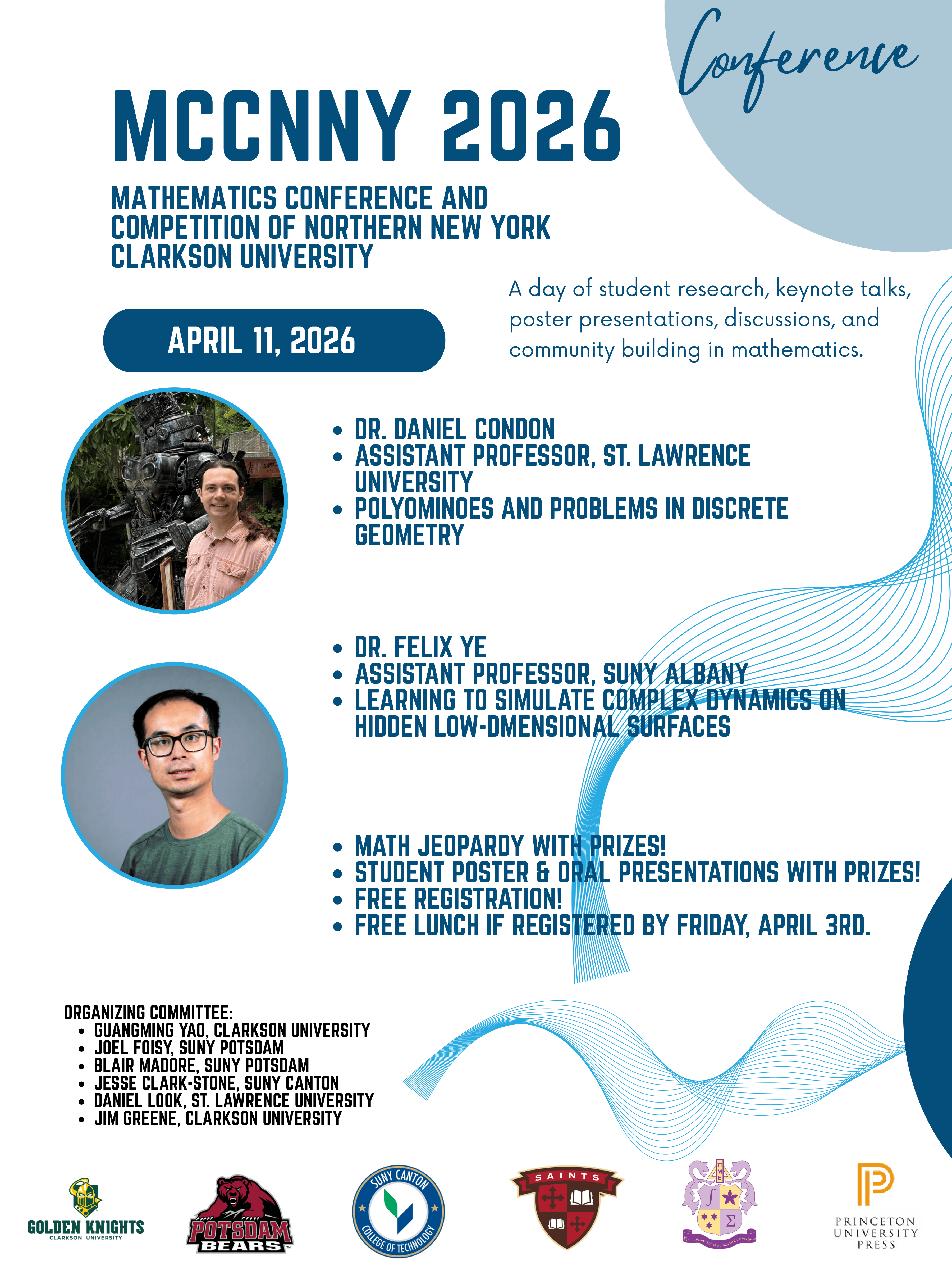

Many systems in science and engineering — from molecular dynamics to climate models — evolve in very high-dimensional spaces, yet their long-time behavior is governed by motion on hidden low-dimensional surface (manifold). If we could find this surface and write down the effective equations of motion on it, we could simulate the system orders of magnitude faster. But the surface is unknown, the equations are unknown, and we may only have access to a black-box simulator that is expensive to run.
In this talk I will describe a two-part research program that addresses this challenge. In the first part, I introduce a data-driven framework (ATLAS) that discovers the hidden manifold and estimates the local dynamics using only short bursts of simulation. ATLAS builds a collection of linear local models at scattered landmarks and stitches them into an efficient reduced simulator that can estimate long-time statistical quantities — such as metastable states and transition rates — far faster than brute-force simulation.
In the second part, I replace the patchwork of linear models with a single neural network autoencoder, trained with geometry-aware penalties derived from the stochastic dynamics data itself. The key insight is that the noise covariance of the process reveals the tangent directions of the hidden surface, providing a form of geometric supervision that is free of coordinate artifacts. I prove that this approach achieves the same statistical learning rate as if we had access to full derivative information, and I derive a new drift formula based on Itô calculus that eliminates a systematic bias present in earlier formulations.
No background in stochastic calculus or Riemannian geometry is assumed; I will develop the key ideas from pictures and intuition.
Oral Presentation Prize
Poster Presentation Prize
Wining Jeopardy Team