Chinese Academy of Sciences: Institute
of Physics
中国科学院物理研究所
===================================================================================================================================================================================
Home Page | Beijing | Nanjing | Meet the Students
Tsinghua University |
Chinese Academy of Science | Life
in Beijing | Wudaoko
===================================================================================================================================================================================
 The Institute of Physics was
established in 1950 as a center for applied physics research. The Academy is different from a university;
there is no undergraduate program, rather the Academy is designed for doctorate
and post-doctorate students. The “campus”
is very small, consisting of only a few buildings and one central building,
where most of the research is conducted.
There is a single dining hall for students and faculty to eat their
meals if they so choose.
The Institute of Physics was
established in 1950 as a center for applied physics research. The Academy is different from a university;
there is no undergraduate program, rather the Academy is designed for doctorate
and post-doctorate students. The “campus”
is very small, consisting of only a few buildings and one central building,
where most of the research is conducted.
There is a single dining hall for students and faculty to eat their
meals if they so choose.
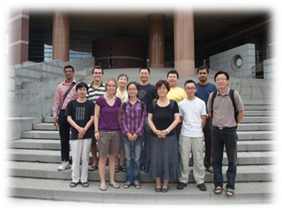
We (Megan and Chris) had the pleasure of working at this
highly-regarded institution this summer, under the mentorship of Dr. Meiying Hou. We worked in the “Granular Materials” lab,
alongside a handful of other graduate students.
The working environment is very relaxed.
You can come into work whenever you choose and leave whenever you’d
like. However, it is your 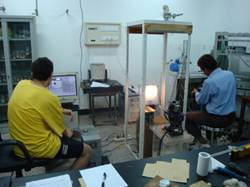 responsibility to get all your work
done. We recommend putting in 8 hours a
day for 5 days a week and then taking the weekends for yourself
to do sightseeing.
responsibility to get all your work
done. We recommend putting in 8 hours a
day for 5 days a week and then taking the weekends for yourself
to do sightseeing.
Take advantage of the grad students. They are almost always willing to help with
whatever you may need, whether it be research related
or help finding your way around town.
They are also full of tips for your tourist excursions. They enjoy laughing at you when you attempt
to speak Chinese, but they also enjoy teaching you how to speak the language
and recognize different characters. You
can tell they appreciate it when you try to learn their language. You’ll also find you will become a teacher as
well. They enjoy trying to improve their
English, and will ask what certain words mean.
After two months “trapped” in an office with them, you’ll find you
become good friends, joking around with each other by the end.
In regards to your research, be sure to prepare beforehand. Don’t expect to waltz into China with no
previous knowledge of your project. You will be extremely overwhelmed and you
will waste the first few weeks gaining knowledge of your project that you could
have gotten before you arrived. Those few
weeks are precious time, as you will most likely find yourself short for time
in the end. Therefore, be sure to
inquire about preparation materials from Dr. Liu/Dr. Shen
before you arrive at Clarkson. You will
be glad you did, as you will find yourself (slightly) less overwhelmed. I should mention, however, that you
are not expected to be experts on your topic.
I personally had no knowledge of granular materials before my research,
and it is understandable that it will take you some time to grasp the full
concept of your project.
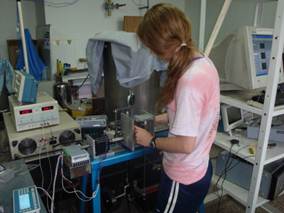
This summer we enjoyed playing with “sand” (as our fellow students
liked to say). We got to hit balls
together, dump beads into boxes, and play with “fancy” equipment! Sounds like fun, right? In more technical terms, balls were hit together
to determine the coefficient of restitution, while beads were packed into a box
and sheared to determine the effect of the shearing on the beads. The fancy equipment included high speed
cameras, dental floss, super glue, motors, a direct shear apparatus, and
displacement indicators. I joke about
the equipment and our experiments because it’s more fun that way, but serious
experimental work did take place.
You may be wondering, just as I did in the beginning, why do we
care about granular materials? The study
of granular materials can be important for many different reasons. Understanding how a granular system reacts
under different conditions can help geologists and geophysicists predict
natural hazards, such as landslides, avalanches, and debris flows, by
determining areas that may be susceptible to these occurrences. Our work is just a small part to a large
“project”. However, every small bit
helps and can be used in further research.
I have a much greater appreciation for the subject now than I did before
I came.
Remember, you’re here to have fun, but you’re here to do
research. Combine the two and you get a
fun research experience. Slap on the
fact that you’re in China, and you’re bound to have a great summer!